

Here is a number worth sitting with: only 1 in 10 UK employees feel genuinely engaged at work. That is not a rounding error. That is the majority of your workforce showing up, doing the job, and not particularly caring how it goes.
For HR leaders and people managers, that figure is both alarming and motivating – because culture is fixable. It is not quick, and it is not always comfortable, but it is absolutely within your control.
This guide covers 12 practical, proven strategies to improve workplace culture, whether you are managing a team of 15 or a company of 1,500. We will skip the vague advice about ‘living your values’ and get into what actually moves the needle.

First, what do we mean by workplace culture?
Culture is one of those words that gets used constantly and defined rarely. So before we talk about how to improve it, let’s agree on what it actually is.
Workplace culture is the collection of behaviours, norms, and unwritten rules that shape how work actually gets done. It is how people treat each other when no one senior is watching. It is whether someone feels safe raising a concern in a meeting, or whether they stay quiet and moan about it in the car park later.
Every organisation has two versions of its culture: the stated culture (the values on the wall, the mission statement, the careers page) and the lived culture (what employees experience every single day). The gap between those two things is where most culture problems live.
Culture is not what you say you stand for. It is what your people feel when they come to work.
Signs your workplace culture needs attention
Culture problems rarely announce themselves loudly. They tend to leak out slowly, in the form of patterns that are easy to dismiss individually but unmistakable collectively.
Watch out for these warning signs:
- High voluntary turnover, especially in the first year of employment
- Employees doing the bare minimum – the quiet quitting trend is almost always a culture symptom
- A lack of psychological safety, where people avoid speaking up, challenging ideas, or admitting mistakes
- Managers who are inconsistent, unavailable, or disengaged themselves
- Recognition that is rare, delayed, or feels like it is going through the motions
- The same issues appearing repeatedly in employee surveys or exit interviews
- A noticeable energy dip – people are present but not really there
Any one of these in isolation might be a blip. Several of them together is a signal worth taking seriously.

How to improve workplace culture: 12 strategies
1. Do a culture audit before you do anything else
You cannot fix what you have not properly diagnosed. A culture audit does not need to be a 50-page consultancy report – it can be as simple as a well-constructed employee survey, a round of honest conversations, or a review of your exit interview data.
Look for patterns in what people say, and pay equal attention to what they do not say. Silence in surveys is data too.
2. Get leadership behaviour aligned with stated values
Culture is modelled from the top and felt from the bottom. If your leadership team talks about psychological safety but shoots down ideas in meetings, or champions work-life balance while emailing at 10pm, the values on the wall become a joke.
Leaders do not need to be perfect. They do need to be consistent, self-aware, and willing to be called out when they drift. Building that kind of accountability at a senior level is one of the fastest ways to shift culture.
3. Build psychological safety into team norms
Psychological safety — the belief that you can speak up without being punished or embarrassed — is one of the most researched predictors of high-performing teams. Google’s Project Aristotle found it was the single biggest differentiator between its best and worst teams.
In practice, this means managers who respond to bad news calmly, who ask questions before making judgements, and who model vulnerability by admitting their own mistakes. It is built in small moments, consistently, over time.
4. Make recognition a habit, not an event
Most organisations do recognition wrong. They wait for the big moments — the annual award, the end-of-year email, the five-year certificate — and miss the hundred small moments in between where people actually needed to feel seen.
Recognition lands best when it is specific, timely, and personal. “Well done on Q3” does very little. “The way you handled that difficult client call on Tuesday was brilliant — you kept the room calm when it could have gone badly wrong” does a great deal.
Build recognition into your rhythms: team stand-ups, one-to-ones, Slack channels, Friday round-ups. Make it normal, make it frequent, and make sure it is not only coming from the top.

5. Use onboarding to set culture from day one
A new employee’s first 90 days are the most formative of their entire tenure. Research consistently shows that employees who have a strong onboarding experience are significantly more likely to still be with you three years later.
Onboarding is a process of integration, not just administration. It is about making someone feel like they made the right decision. That means a warm welcome, a clear sense of what good looks like, introductions to the right people, and enough structure that they are not left floundering.
Culture is absorbed, not taught. The quicker a new hire can see your culture in action – how people interact, how problems are solved, how wins are celebrated – the quicker they will feel genuinely part of it.
6. Celebrate milestones and work anniversaries
Work anniversaries are underused. In most organisations, a one-year or five-year mark gets a LinkedIn post from the company account and maybe a small gift. That is a missed opportunity.
Milestones are moments of genuine connection. They say: we noticed, we remember, we care that you chose to stay. When handled thoughtfully, they build loyalty in a way that few other gestures can.
The same goes for personal milestones – new babies, significant life events, exam results. The organisations that acknowledge the full person, and not just the employee, tend to build the cultures people genuinely do not want to leave.
7. Run stay interviews
Exit interviews tell you why someone left. Stay interviews tell you what is keeping your good people – and what might eventually push them out.
A stay interview is a simple, structured conversation with a current employee, usually conducted by their manager, with questions like: What do you look forward to when you come to work? What would make you consider leaving? What would make your role more fulfilling?
The intelligence you get from these conversations is more actionable than any engagement survey. They also signal to your employees that you are paying attention – which, in itself, has a positive effect on engagement.
8. Create real channels for two-way feedback
Feedback loops only work if people trust they will be listened to. A quarterly survey that produces no visible action trains employees to disengage from the process entirely.
Close the loop, every time. When employees raise something – formally or informally – tell them what you have heard, what you are going to do about it, and what you cannot change and why. Transparency about the limits of action is still far better than silence.

9. Invest in manager development
Managers are the carriers of culture. Your values mean nothing if the person delivering them is burning their team out, hoarding feedback, or playing favourites.
Management-related reasons for leaving hit a six-year high in 2025, according to the Work Institute’s Retention Report. That is a stark reminder that culture is experienced most immediately in the relationship between an employee and their line manager.
Investing in manager capability – coaching skills, feedback conversations, how to run a good one-to-one – is one of the highest-leverage things you can do for culture.
10. Treat wellbeing as a cultural issue
Wellbeing programmes that live in the perks column – a meditation app subscription here, a free gym membership there – rarely move the dial on how people actually feel at work.
Genuine wellbeing culture means workloads that are manageable, managers who notice when someone is struggling, and an environment where people do not feel they need to perform being fine when they are not.
The CIPD’s 2025 Health and Wellbeing at Work report found that heavy workloads remain the primary cause of stress-related absence in the UK. The solution to that is structural, not cosmetic.
11. Acknowledge the moments that matter to your team
A culturally aware calendar is good for business. Marking moments like Mental Health Awareness Week, International Women’s Day, Black History Month, or Diwali in a meaningful way sends a clear message: everyone belongs here, and we see you.
The key word is meaningful. Awareness without action feels hollow. Pair acknowledgement with education, conversation, or a genuine gesture – and make sure it is consistent year on year, not reactive.
12. Use corporate gifting to create tangible moments of appreciation
There is a reason physical gifts land differently to a verbal well done or a Slack message. They are tangible, they exist beyond the moment, and they sit on someone’s desk or kitchen worktop and remind them, days later, that they were thought of.
Corporate gifting – done well – is a culture strategy. It is the physical expression of a recognition culture. When a new employee receives a thoughtfully curated welcome box on their first day, it signals something about the kind of company they have joined. When a team that has pushed through a brutal quarter gets a box delivered to their door, it says: we see the effort, not just the output.
The most effective gifting is personal, well-timed, and aligned with your values as a business. Sustainable brands, wellbeing-focused products, quality over quantity – these choices communicate culture just as much as any internal communications campaign.
The best corporate gifts do not just say thank you. They say: we know who you are, and we are glad you are here.
At WellBox, we help businesses turn gifting into a genuine culture tool – from first-day welcome boxes to team recognition gifts and client appreciation. Explore our gift collections to see how thoughtful gifting can support the kind of workplace culture your people actually want to be part of.

Culture change is a long game – start with one thing
Twelve strategies is a lot to absorb. The good news is that you do not have to do them all at once.
The most effective culture transformations tend to start with one thing done consistently well. Pick the strategy that addresses your biggest current pain point — whether that is recognition, psychological safety, manager capability, or onboarding — and focus there for 90 days before you expand.
Culture is built in the accumulation of small, everyday moments. How someone is greeted on their first day. Whether their manager noticed they had a hard week, whether they were included in a decision that affected their role, and whether someone took the time to say thank you in a way that felt real.
None of those moments are complicated. All of them matter.
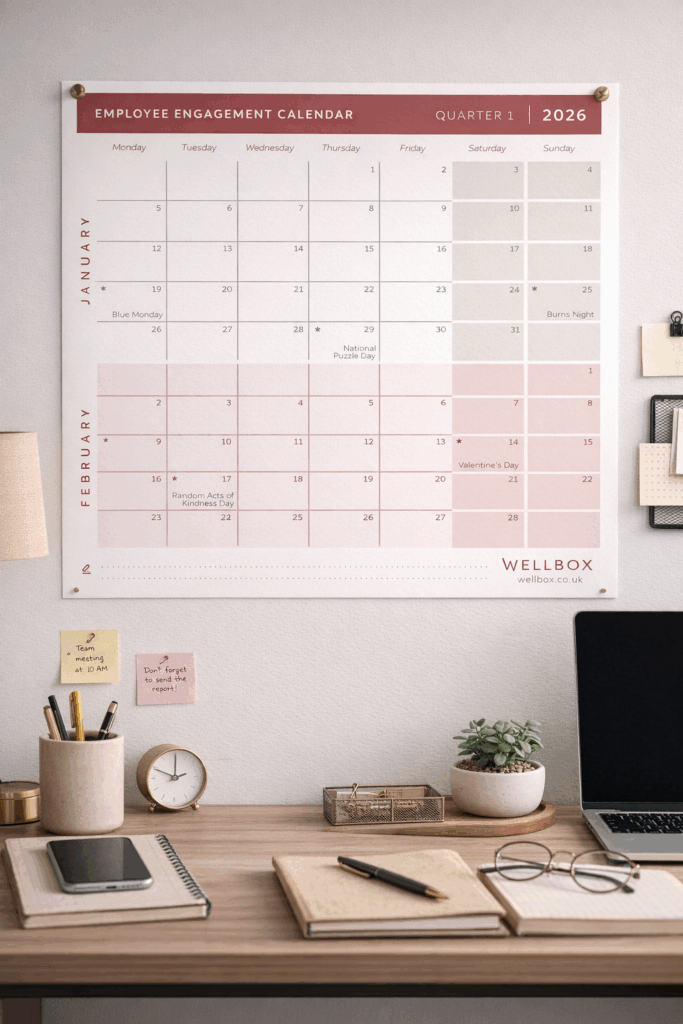
If you are looking for a practical starting point, our Employee Engagement Key Dates Calendar gives you a year’s worth of cultural moments to build around — from awareness days to seasonal gifting prompts. Download it below!
Frequently asked questions
How long does it take to improve workplace culture?
Meaningful culture change typically takes 12 to 24 months to become embedded — but you will often see shifts in engagement and morale within the first 90 days of consistent effort. The key is consistency. Culture is not a project with a completion date.
What is the most important factor in workplace culture?
Leadership behaviour is consistently identified as the single biggest driver of culture. How senior leaders communicate, make decisions, and treat people sets the tone for everything else. Management capability at every level follows closely behind.
How do you measure workplace culture?
The most commonly used methods are employee engagement surveys, pulse surveys, stay and exit interview data, eNPS (Employee Net Promoter Score), and absenteeism and turnover rates. No single metric tells the full story — the most useful picture comes from combining quantitative data with qualitative conversation.
What is the difference between workplace culture and employee engagement?
Culture is the environment; engagement is a measure of how employees respond to it. You can think of culture as the soil and engagement as whether things are growing. High engagement is usually a sign of a healthy culture, but engagement scores alone will not tell you why things are the way they are.
Can small businesses improve workplace culture with a limited budget?
Absolutely. Some of the most impactful culture-building actions cost nothing: consistent recognition, honest feedback conversations, stay interviews, and simply paying attention to how people are doing. Budget helps when it comes to tools, training, and gestures like gifting — but culture is primarily built through behaviour, not spend.
How does corporate gifting support workplace culture?
Gifting creates tangible moments of recognition that reinforce a culture of appreciation. Used at key moments – new hire onboarding, work anniversaries, team milestones, awareness calendar dates — it makes recognition feel considered and personal. The most effective gifting programmes are consistent, values-aligned, and tied to genuine moments rather than obligation.
