

Supporting employee mental health is one of the most important things an organisation can do. It’s also one of the most misunderstood.
For many HR and People teams, mental health support still lives in the policy layer – an EAP buried in the employee handbook, a mental health first aider whose name nobody can remember, a wellbeing survey that gets sent once a year and quietly filed away. The intention is there. The impact, often, isn’t.
The organisations that get this right treat mental health as a cultural commitment – one that shows up in how they lead, how they communicate, how they recognise people, and how they respond when someone is struggling.
This guide is for HR and People teams who want to move from intention to impact. It covers the practical, the structural, and the human – because supporting employee mental health well requires all three.
Why employee mental health support matters more than ever
The numbers are stark. One in four people in the UK will experience a mental health problem in any given year. Depression and anxiety alone account for 51% of all work-related ill health cases, and 55% of all working days lost to ill health, according to the Health and Safety Executive.
The cost to employers is significant – an estimated £56 billion a year in the UK, according to Deloitte, when you factor in presenteeism, absenteeism, and staff turnover. But the human cost is the more important number. Behind every statistic is a person who came to work carrying something difficult, and either felt supported by their employer or didn’t.
The good news is that the return on investment for mental health support is compelling. Deloitte’s research found that for every £1 invested in employee mental health, employers see an average return of £5.30 through reduced absence, increased productivity, and lower turnover. Mental health support isn’t a cost. It’s one of the highest-returning investments an organisation can make.

The difference between having a policy and having a culture
Most organisations have a mental health policy. Far fewer have a mental health culture.
A policy tells employees what support exists. A culture tells them it’s safe to use it. And that gap – between what’s available on paper and what people actually feel able to access – is where most mental health strategies quietly fail.
Building a culture of genuine mental health support requires consistent signals over time. Not a single awareness campaign, not one well-meaning email from the CEO, but a sustained, visible commitment that employees experience in their day-to-day working lives.
That commitment shows up in small things as much as large ones. How managers respond when someone asks for flexibility. Whether leaders talk openly about their own struggles. How the organisation marks moments like Mental Health Awareness Week. Whether recognition and appreciation are built into the rhythm of work, or saved for annual reviews.
Practical ways to support employee mental health at work
Make mental health visible at leadership level
The single most powerful thing a senior leader can do for employee mental health is talk about it honestly. When a CEO or MD shares a personal experience of stress, burnout, or anxiety – not performatively, but genuinely – it shifts the cultural temperature of an entire organisation.
It signals that struggle is ordinary, not a weakness. It gives people permission to be honest about their own experience. And it makes it significantly easier for employees at every level to reach out for support without fear of judgement.
This doesn’t require a dramatic disclosure. A short video message, an internal blog post, or a few minutes at the start of an all-hands meeting is enough. The format matters less than the authenticity.
Train managers to have better conversations
Managers are the frontline of employee mental health support – whether they know it or not. Research consistently shows that the relationship with a direct manager is one of the strongest predictors of employee wellbeing. A good manager can catch early signs of struggle, create space for honest conversation, and signpost support before someone reaches a crisis point. A poor one can make existing mental health challenges significantly worse.
Mental health awareness training for managers isn’t a luxury. It’s a baseline. At minimum, managers should understand how to have a supportive conversation, know what resources are available, and feel confident enough to raise a concern without overstepping.

Remove the barriers to accessing support
One of the most common reasons employees don’t use mental health support is that they don’t know it exists, don’t feel comfortable using it, or find it too complicated to access.
Review your existing provision – EAP, counselling referrals, mental health first aiders – and ask honestly: do employees know about this? Is it easy to use? Does it feel safe and confidential?
If the answer to any of those is no, visibility and accessibility are the priority before anything else. Even the best EAP is worthless if no one knows the phone number.
Build recognition into everyday working life
Feeling valued is one of the most protective factors for mental health at work. Employees who feel genuinely recognised are more engaged, more resilient, and less likely to experience burnout. Those who feel overlooked or underappreciated are significantly more vulnerable to stress and disengagement.
Recognition doesn’t have to be expensive or elaborate. Consistent, specific, timely acknowledgement – from managers and peers – makes a measurable difference. The key word is consistent. Recognition that only happens at annual reviews or during awareness weeks doesn’t build the psychological safety that protects mental health. It needs to be woven into how the organisation operates every week of the year.
Create space for open conversation
Psychological safety – the sense that it’s safe to speak up, share concerns, and be honest about struggles without fear of negative consequences – is foundational to mental health at work. And it doesn’t happen by accident.
It requires leaders who model honesty and vulnerability. Managers who respond to difficult conversations with curiosity rather than defensiveness. Team cultures where difference of opinion is welcomed and mistakes are treated as learning opportunities rather than failures.
Practically, this might look like regular team check-ins that include a genuine wellbeing question. Or a management approach that explicitly separates performance conversations from wellbeing ones. Or simply a leader who says, at the start of a meeting: how is everyone actually doing?
The question itself matters less than the consistency and the sincerity with which it’s asked.
Use awareness moments as a launchpad, not a destination
Mental Health Awareness Week, World Mental Health Day, Stress Awareness Month – these calendar moments are valuable. They create momentum, give permission for conversation, and provide a natural hook for internal communications.
But the organisations that make the most of them treat them as a launchpad, not a destination. They use the heightened attention of an awareness week to introduce something that continues – a new resource, a policy change, a manager training programme, a recognition initiative – rather than running a campaign that disappears on the 18th.
What you do during Mental Health Awareness Week signals your values. What you do the week after tells people whether you meant it.
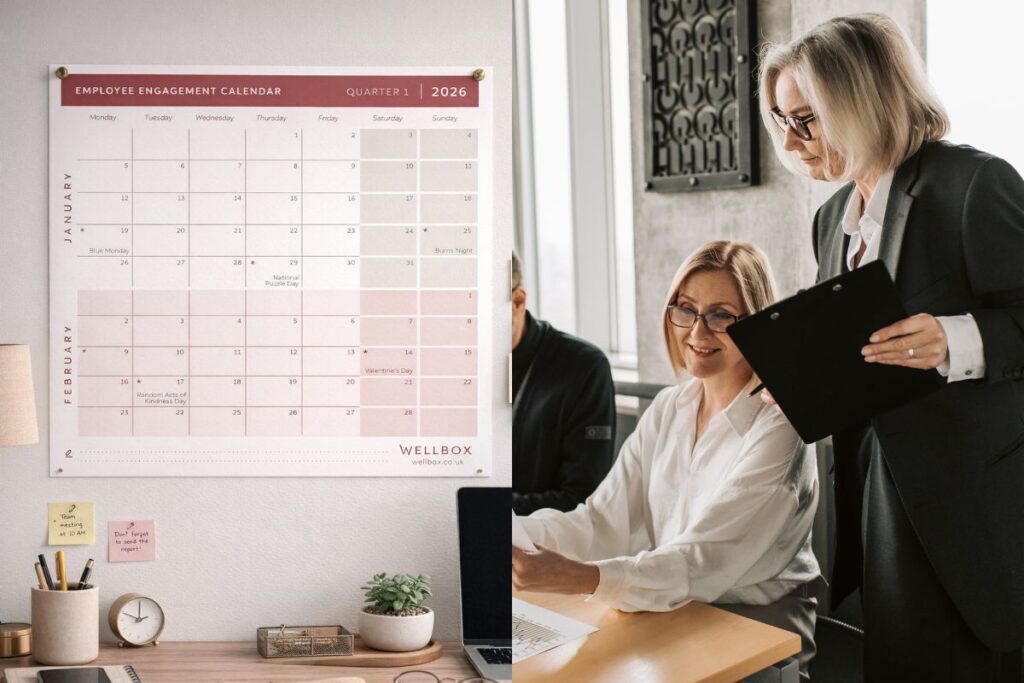
🚨Struggling to keep track on employee engagement opportunities throughout the year?
Download our FREE employee engagement calendar below and stay on track all year long.
What to do during Mental Health Awareness Week specifically
Mental Health Awareness Week runs 11–17 May 2026. For HR and People teams, it’s one of the most significant moments in the annual calendar – and one where the gap between organisations that genuinely invest in employee wellbeing and those that don’t becomes very visible.
Here are the things that land best during the week itself:
Visible leadership. A message from the CEO or senior leadership that goes beyond corporate language – honest, human, and specific about what the organisation is committing to.
Open conversation spaces. A dedicated team session, an optional drop-in, or a structured discussion that gives employees a genuine opportunity to talk – on their own terms, without pressure.
Access to resources. Use the week to actively promote whatever mental health support is available. Don’t assume employees know. Tell them again, clearly and warmly.
Tangible recognition. A thoughtful wellbeing gift – something curated, personal, and purposeful – is one of the most effective ways to make the week feel real rather than corporate. Not a branded stress ball. Something that genuinely says: we thought about you.
A commitment to what comes next. The organisations that use MHAW to announce something lasting – a new policy, a new resource, a new approach – get more out of the week than those that treat it as a standalone event.
The role of gifting in employee mental health support
A wellbeing gift might feel like a small thing set against the structural work of building a mentally healthy workplace. But timing and intention matter enormously.
A thoughtful gift – curated around calm, restoration, and everyday joy – that arrives during Mental Health Awareness Week sends a signal that goes beyond its contents. It says: we knew this week was coming. We thought about you. And we wanted to mark it in a way that you could actually feel.
That signal lands differently from a policy update or an internal comms campaign. It’s tangible. It’s personal. And it creates a moment of genuine connection between employer and employee at exactly the right time.
At WellBox, our Limited Edition MHAW Gift is built for this moment. Every gift is curated to bring calm and brightness to everyday life – and every one includes a £1 donation to Mind, the UK’s leading mental health charity. Because we believe that the best gifts don’t just look good. They mean something.
From £18.95 per gift. Free UK delivery. No addresses needed – just a list of email addresses and we handle the rest.

Building something that lasts beyond the week
Supporting employee mental health well isn’t a campaign. It’s a commitment.
The practical steps in this guide – visible leadership, manager training, accessible support, consistent recognition, psychological safety – aren’t MHAW initiatives. They’re the building blocks of a culture where people genuinely feel supported all year round.
Mental Health Awareness Week is a valuable moment to take stock, make a visible gesture, and recommit to the work. But the organisations that make the biggest difference are the ones that treat it as one point on a continuous journey – not the whole journey itself.
Your people notice the difference. And increasingly, so do the candidates deciding whether to join you, and the employees deciding whether to stay.
